Why Your Template Folder Is Full and Your Output Is Empty
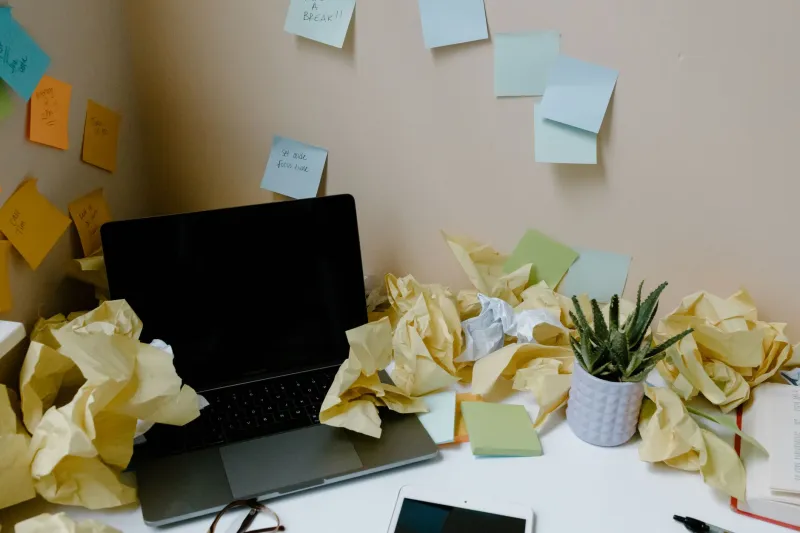
Let's be honest for a second. You've got folders. Maybe it's a Google Drive labeled "Resources" that you reorganized twice and haven't touched since. Maybe it's a Notion database full of templates you downloaded on a productive-feeling Sunday afternoon. Maybe it's a collection of Canva layouts, spreadsheet frameworks, and content calendars that are just... sitting there.
You're not alone. This is one of the most common—and least talked about—traps in the creator world. And it's costing you more than you probably realize.
The Collector's High Is Real (And It's Misleading)
There's a very specific dopamine hit that comes from downloading a great template. It feels like progress. You found a solution, you grabbed it, you filed it away. Your brain registers that as a win.
Except nothing actually got done.
This is what psychologists sometimes call pseudo-productivity—the feeling of accomplishment without the actual output. For creators especially, this pattern is dangerously easy to fall into because the tools we use are genuinely exciting. A well-designed content calendar template does look like it could change your workflow. A client onboarding kit does seem like exactly what you've been missing.
The problem isn't that you got the template. The problem is that acquiring it scratched the itch that actually doing the work would have scratched. So now you don't feel the urgency to implement it.
Decision Fatigue Is Quietly Wrecking Your Workflow
Here's where the digital clutter gets really sneaky. Every unused template in your library isn't neutral—it's actively working against you.
When you open your resources folder looking for help, you're not greeted with clarity. You're greeted with options. Dozens of them. And your brain, which is already taxed from the creative work you're trying to do, now has to evaluate which template is the right one, whether you've already tried this one, whether there's a better version somewhere, and whether you should just start from scratch.
That decision fatigue is a real productivity killer. Research on cognitive load consistently shows that more choices don't lead to better decisions—they lead to paralysis, avoidance, or settling for a subpar option just to escape the overwhelm. For creators working solo or on small teams, this is especially brutal because there's no one else to delegate the decision to.
Your template graveyard isn't just clutter. It's a friction machine.
The "Just One More" Trap
Here's the cycle most creators are stuck in: you hit a wall on a project, you go looking for a tool or template to solve it, you find something promising, you download it, you feel briefly better, you don't implement it, and then next time you hit a wall, you go looking again.
Rinse, repeat, accumulate.
The "just one more template" instinct feels rational—like you're being resourceful. But it's often a form of sophisticated procrastination dressed up as preparation. You're not getting ready to work. You're avoiding work by simulating the act of getting ready.
This is worth sitting with for a minute, because it's not a character flaw. It's a behavioral pattern that makes total sense given how creator tools are marketed. Every product promises to be the missing piece. And when you're in the middle of a hard project, the promise of a missing piece is very seductive.
A Framework for Actually Using What You Have
So how do you break the cycle? Here's a practical approach that works for a lot of creators:
Step 1: Freeze new acquisitions for 30 days. No new templates, no new tools, no new downloads for a month. This feels uncomfortable at first, which is actually useful data. If you're itching to grab something new within the first week, that's a sign you're using acquisition as avoidance.
Step 2: Do a one-hour audit of what you actually own. Open every folder. List what's in there. Don't organize it yet—just inventory it. You'll probably find duplicates, stuff you forgot existed, and a few genuine gems buried under the noise.
Step 3: Apply a simple filter: use it or lose it. For each template, ask one question: Can I put this to work on something I'm doing right now? If yes, move it to an active workspace. If no, archive it or delete it. The goal isn't to have a perfect library. It's to have a functional one.
Step 4: Set a "first use" rule going forward. Before you download or purchase anything new, you have to have fully used at least one existing resource first. This creates a natural throttle on accumulation and forces you to actually implement before you acquire.
Lean Beats Loaded Every Time
There's a temptation to think that having more resources makes you more capable. But most high-output creators will tell you the opposite is true. The people who consistently produce great work usually have a small, well-worn set of tools they know inside and out—not a sprawling archive of things they might use someday.
A content calendar you actually fill out every week beats a dozen content calendar templates you've never opened. A simple invoice template you've customized to your brand beats a fancy client portal you set up once and abandoned.
The goal isn't to have the best tools. It's to do your best work. And that distinction matters a lot when you're sitting down to actually create something.
Turning Your Graveyard Into a Go-To Arsenal
Once you've done the audit and cleared out the noise, you'll likely find that what's left is pretty manageable. Maybe five to ten templates that are genuinely relevant to how you work. That's your real toolkit.
From there, the move is to actually customize them. Put your name on them. Adapt them to your specific workflow. Add notes about how you use them. The more personalized a template feels, the more likely you are to reach for it instead of going looking for something new.
At MProject Store, the tools and templates we offer are built with this in mind—not to add to your pile, but to replace the stuff that isn't working with something you'll actually use. Because a template that sits in a folder isn't a resource. It's just a good intention that never went anywhere.
Your output doesn't need more raw material. It needs less friction between you and the work. Start there.